08 · Any EDA in, any engine out
07_choosing_an_engine showed one job running on three engines. This is the
mirror image — and then the two axes together. However your geometry is
authored — programmatically in gdsfactory, in a KLayout/SiEPIC foundry PDK,
or as a plain GDS from any tool — gds_fdtd ingests it, auto-detects the
ports, and hands you the same engine-agnostic Component. From there the
identical validate → build → run drives beamz, tidy3d, or Lumerical.
Frontend |
How you get geometry |
Entry point |
|---|---|---|
gdsfactory |
parametric Python components (PDK) |
|
KLayout / SiEPIC |
a foundry PDK cell |
|
raw GDS |
any |
|
PreFab |
a lithography-predicted GDS |
|
The last section is the full frontend × engine matrix: three devices — one from each frontend — each simulated on all three engines, with recorded results so this notebook reproduces for free.
import json
import os
from pathlib import Path

import matplotlib.pyplot as plt
import numpy as np

from gds_fdtd.lyprocessor import load_cell
from gds_fdtd.plotting import plot_component, plot_permittivity
from gds_fdtd.simprocessor import load_component_from_tech
from gds_fdtd.smatrix import SMatrix
from gds_fdtd.spec import SimulationSpec
from gds_fdtd.technology import Technology


def _find(rel: str) -> Path:
    for base in (Path.cwd(), *Path.cwd().parents):
        if (base / rel).exists():
            return base / rel
    raise FileNotFoundError(rel)


REC = _find("examples/08_frontends/recorded")
tech = Technology.from_yaml(_find("examples/tech.yaml"))
components = {}  # frontend label -> Component
1 · gdsfactory — parametric, programmatic
gdsfactory builds components in
Python. from_gdsfactory reads the polygons on each technology layer and
lifts the gdsfactory ports into gds_fdtd ports. The device: a gentle
S-bend (bend_s, 5×1 µm), used again in the matrix at the end.
import gdsfactory as gf  # noqa: E402

from gds_fdtd.layout.gdsfactory import from_gdsfactory  # noqa: E402

gf.gpdk.PDK.activate()
gf_bend = from_gdsfactory(gf.components.bend_s(size=(5.0, 1.0)), tech)
gf_bend.name = "gf_bend_s"
components["gdsfactory\nbend_s"] = gf_bend
18:55:04 PDT WARNING: Using canonical configuration directory at
             '/home/mustafa/.config/tidy3d'. Found legacy directory at
             '~/.tidy3d', which will be ignored. Remove it manually or run
             'tidy3d config migrate --delete-legacy' to clean up.
2 · KLayout / SiEPIC — a foundry PDK
The same reader consumes a cell straight from the SiEPIC EBeam PDK (the
ebeam_y_1550 y-branch) — KLayout pin + DevRec conventions become ports and
bounds automatically. This is the path most silicon-photonics tapeouts use,
and it feeds every engine (beamz reads the extruded polygons through a
component shim).
try:
    import siepic_ebeam_pdk as pdk

    gds = os.path.join(os.path.dirname(pdk.__file__), "gds", "EBeam", "ebeam_y_1550.gds")
    cell, _ = load_cell(gds, top_cell="ebeam_y_1550")
    ybranch = load_component_from_tech(cell=cell, tech=tech)
    ybranch.name = "ebeam_y_1550"
    components["SiEPIC\nebeam_y_1550"] = ybranch
except ImportError:
    print("(install siepic_ebeam_pdk to load the SiEPIC PDK cell)")
SiEPIC-EBeam-PDK Python module: siepic_ebeam_pdk, KLayout technology: EBeam
KLayout SiEPIC-Tools version 0.5.31
SiEPIC-Tools is up to date (0.5.31 vs 0.5.31).
Version check, time: 0.28484654426574707 seconds
SiEPIC-EBeam-PDK Python module: pymacros, v0.4.53
Libraries associated with Technology EBeam: ['EBeam', 'EBeam-ANT', 'EBeam-Dream', 'EBeam-SiN', 'EBeam_Beta']
3 · A raw GDS file — from any tool
No PDK, no framework: point load_cell at any .gds whose polygons land on
the technology’s device/pin/DevRec layers. Here it is sbend_dontfabme from
examples/devices.gds, the sharp S-bend that 06_convergence_and_caching
uses as its stress test.
cell, _ = load_cell(str(_find("examples/devices.gds")), top_cell="sbend_dontfabme")
sbend = load_component_from_tech(cell=cell, tech=tech)
sbend.name = "sbend_dontfabme"
components["raw GDS\nsbend_dontfabme"] = sbend
4 · PreFab — lithography-aware geometry
PreFab predicts how a nanofabrication
process will actually print your design (corner rounding, proximity
effects). load_device runs the model and writes a <cell>_predicted.gds,
which then flows through the identical path as any raw GDS. It needs a PreFab
account + network, so it’s a recipe here:
from gds_fdtd.lyprocessor import load_device
predicted = load_device(
    "my_design.gds", tech=tech, top_cell="my_cell",
    prefab_model="ANT_NanoSOI_ANF1_d10", output_dir="out/",
)
5 · One Component, whatever the source
Each frontend produced the same kind of object — device polygons, auto-detected ports, bounds. First the standard geometry views:
n = len(components)
fig, axes = plt.subplots(1, n, figsize=(5.5 * n, 4.5))
axes = np.atleast_1d(axes)
for ax, (name, comp) in zip(axes, components.items(), strict=True):
    plot_component(comp, spec=SimulationSpec(), ax=ax)
    ax.set_title(name)
    ax.legend().set_visible(False)
fig.tight_layout()
plt.show()

for name, comp in components.items():
    print(
        f"{name.replace(chr(10), ' '):26s}: {len(comp.ports)} ports {[p.name for p in comp.ports]}"
    )
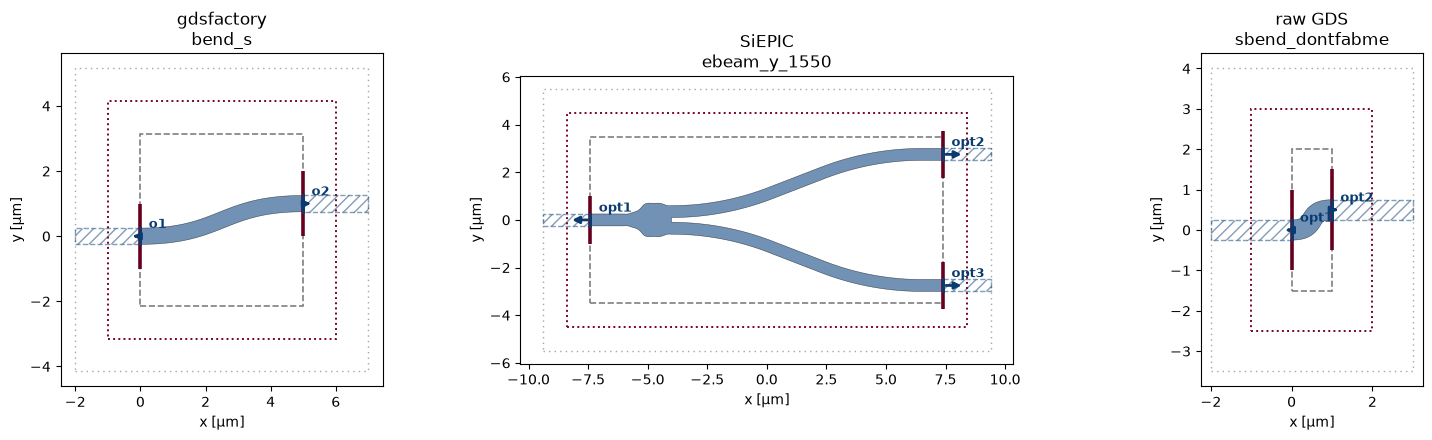
gdsfactory bend_s         : 2 ports ['o1', 'o2']
SiEPIC ebeam_y_1550       : 3 ports ['opt1', 'opt2', 'opt3']
raw GDS sbend_dontfabme   : 2 ports ['opt2', 'opt1']
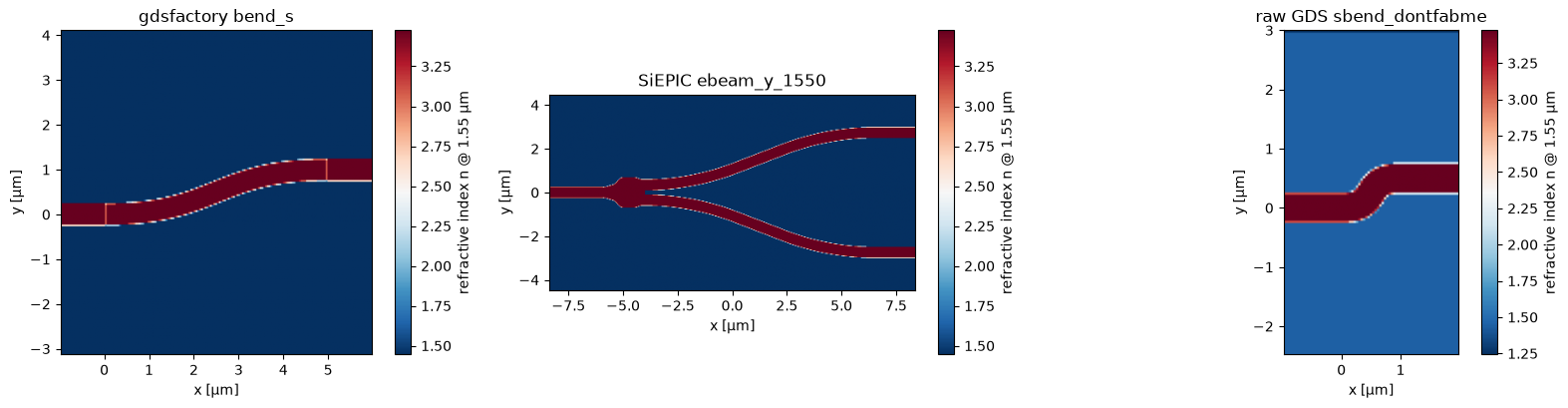
…and, more stringently, what the solvers actually mesh: the rasterized refractive-index map of each device at the Si core mid-plane. Same reader, same extrusion, same materials — regardless of which tool drew the polygons.
fig, axes = plt.subplots(1, n, figsize=(5.5 * n, 4.2))
axes = np.atleast_1d(axes)
for ax, (name, comp) in zip(axes, components.items(), strict=True):
    plot_permittivity(comp, dx=0.04, axis="z", position=0.11, ax=ax)
    ax.set_title(name.replace(chr(10), " "))
fig.tight_layout()
plt.show()
6 · The frontend × engine matrix
Now both axes at once. Three devices — one from each frontend — each run
on all three engines with the identical (component, technology, spec):
device |
frontend |
engines |
results |
|---|---|---|---|
|
gdsfactory |
beamz · tidy3d · Lumerical |
|
|
SiEPIC PDK |
beamz · tidy3d · Lumerical |
|
|
raw GDS |
beamz · tidy3d · Lumerical |
|
The recorded artifacts are each engine’s real output (beamz on this CPU, tidy3d on the cloud, Lumerical on a licensed workstation).
ENGINES = ("beamz", "tidy3d", "lumerical")

# gdsfactory bend: three full SMatrices recorded next to this notebook
bend_sm = {e: SMatrix.from_npz(str(REC / f"gf_bend_s_{e}.npz")) for e in ENGINES}
# SiEPIC y-branch: three full SMatrices recorded for 07
yb_dir = _find("examples/07_choosing_an_engine/recorded")
yb_sm = {e: SMatrix.from_npz(str(yb_dir / f"ybranch_{e}.npz")) for e in ENGINES}
# raw-GDS sharp sbend: single-wavelength convergence records from 06 (finest mesh each)
sb_dir = _find("examples/06_convergence_and_caching/recorded")
sb = {}
for e in ENGINES:
    mesh_map = json.loads((sb_dir / f"sbend_{e}_convergence.json").read_text())["mesh"]
    finest = str(max(int(k) for k in mesh_map))
    sb[e] = mesh_map[finest]["s21_db"]


def s21_at(sm: SMatrix, wl: float = 1.55) -> float:
    i = int(np.argmin(np.abs(sm.wavelength_um - wl)))
    return float(sm.magnitude_db(out=2, in_=1)[i])


matrix = {
    "gf_bend_s (gdsfactory)": {e: s21_at(bend_sm[e]) for e in ENGINES},
    "ebeam_y_1550 (SiEPIC)": {e: s21_at(yb_sm[e]) for e in ENGINES},
    "sbend_dontfabme (raw GDS)": {e: float(sb[e]) for e in ENGINES},
}
print(f"{'S21 @ 1.55 µm [dB]':28s}" + "".join(f"{e:>12s}" for e in ENGINES) + f"{'worst |Δ|':>12s}")
for dev, row in matrix.items():
    vals = list(row.values())
    spread = max(vals) - min(vals)
    print(f"{dev:28s}" + "".join(f"{v:>12.2f}" for v in vals) + f"{spread:>12.2f}")
S21 @ 1.55 µm [dB]                 beamz      tidy3d   lumerical   worst |Δ|
gf_bend_s (gdsfactory)             -0.31       -0.05       -0.01        0.30
ebeam_y_1550 (SiEPIC)              -3.18       -3.20       -3.20        0.03
sbend_dontfabme (raw GDS)          -1.99       -5.64       -5.63        3.65
The same table as a picture — each cell is one engine’s S21 for one device, colored by how far it sits from that device’s median (so a perfectly agreeing row is uniformly pale):
devs = list(matrix)
vals = np.array([[matrix[d][e] for e in ENGINES] for d in devs])
dev_from_median = vals - np.median(vals, axis=1, keepdims=True)
fig, ax = plt.subplots(figsize=(8.5, 3.6))
im = ax.imshow(np.abs(dev_from_median), cmap="magma_r", vmin=0, vmax=4, aspect="auto")
for i in range(len(devs)):
    for j in range(len(ENGINES)):
        ax.text(
            j,
            i,
            f"{vals[i, j]:.2f}",
            ha="center",
            va="center",
            color="k" if abs(dev_from_median[i, j]) < 2 else "w",
            fontsize=11,
        )
ax.set_xticks(range(len(ENGINES)), ENGINES)
ax.set_yticks(range(len(devs)), devs)
ax.set_title("S21 @ 1.55 µm [dB] — frontend × engine (color = |deviation from row median|)")
fig.colorbar(im, ax=ax, label="|Δ from median| [dB]")
fig.tight_layout()
plt.show()
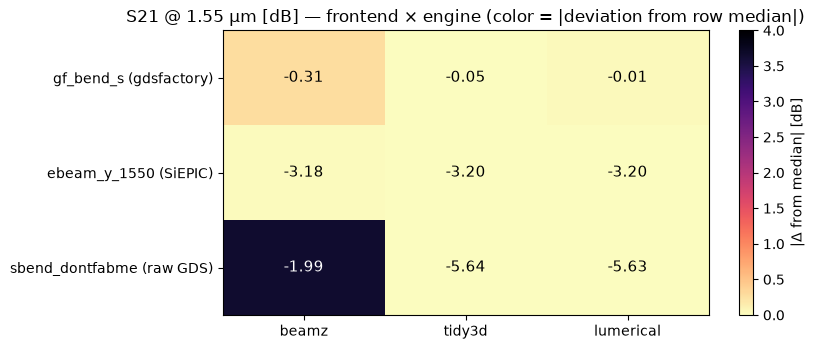
Reading the matrix:
gf_bend_s(gentle, adiabatic): all three engines agree — beamz is trustworthy on gradual structures, whatever frontend supplied them.ebeam_y_1550(SiEPIC): all three agree on the −3 dB split to ~0.16 dB (see07for the full analysis and beamz’s reverse-column caveat).sbend_dontfabme(sharp): tidy3d and Lumerical agree to ~0.03 dB while beamz sits ~3.6 dB off and never converges — the06_convergence_and_cachinglesson, visible here as the one dark cell.
The takeaway: agreement (or disagreement) is a property of the physics and the engine, not of which EDA tool drew the layout.
The gdsfactory row in full — spectra on all three engines
The matrix shows one number; here is the whole band for the gdsfactory S-bend: through-port S21 (top) and reflection S11 (bottom) from each engine.
fig, (axT, axR) = plt.subplots(2, 1, figsize=(8, 7), sharex=True)
colors = {"beamz": "tab:blue", "tidy3d": "tab:red", "lumerical": "tab:green"}
marks = {"beamz": "o-", "tidy3d": "s--", "lumerical": "^:"}
for e in ENGINES:
    sm = bend_sm[e]
    axT.plot(
        sm.wavelength_um, sm.magnitude_db(out=2, in_=1), marks[e], color=colors[e], ms=4, label=e
    )
    axR.plot(
        sm.wavelength_um, sm.magnitude_db(out=1, in_=1), marks[e], color=colors[e], ms=4, label=e
    )
axT.set_ylabel("S21 [dB]")
axR.set_ylabel("S11 [dB]")
axR.set_xlabel("wavelength [µm]")
axT.set_title("gf_bend_s — one gdsfactory device, three engines")
for a in (axT, axR):
    a.grid(alpha=0.3)
    a.legend(fontsize=8)
fig.tight_layout()
plt.show()

s21s = {e: s21_at(bend_sm[e]) for e in ENGINES}
worst = max(s21s.values()) - min(s21s.values())
print("gf_bend_s S21 @1.55: " + "  ".join(f"{e} {v:+.2f} dB" for e, v in s21s.items()))
print(f"three-engine spread: {worst:.2f} dB on a gdsfactory-authored device")
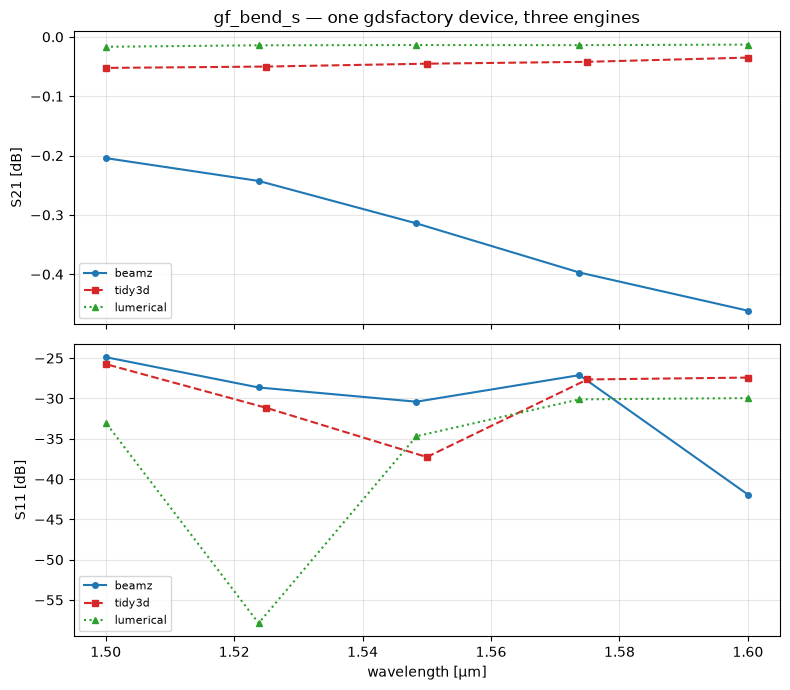
gf_bend_s S21 @1.55: beamz -0.31 dB  tidy3d -0.05 dB  lumerical -0.01 dB
three-engine spread: 0.30 dB on a gdsfactory-authored device
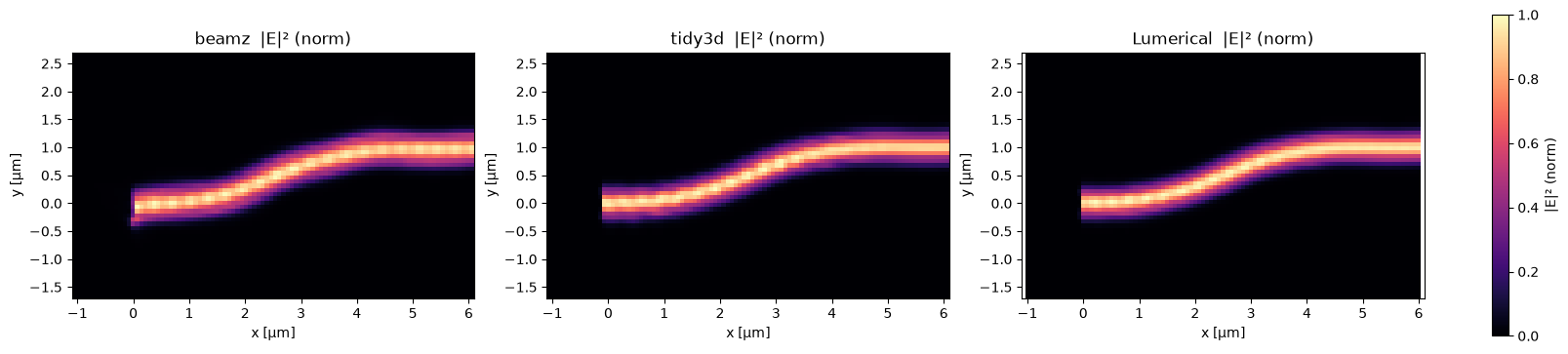
…and the same run as fields: |E|² through the bend from each engine, every panel on its own true grid coordinates (beamz uniform; tidy3d adaptive; Lumerical graded). One gdsfactory device, three engines, one guided field.
b = np.load(REC / "gf_bend_s_field_beamz.npz")
t = np.load(REC / "gf_bend_s_field_tidy3d.npz")
lu = np.load(REC / "gf_bend_s_field_lumerical.npz")
cx, cy = gf_bend.bounds.x_center, gf_bend.bounds.y_center
bw, bh = float(b["width_um"]), float(b["height_um"])
field_panels = [
    (
        "beamz",
        np.linspace(cx - bw / 2, cx + bw / 2, b["E2"].shape[1]),
        np.linspace(cy - bh / 2, cy + bh / 2, b["E2"].shape[0]),
        b["E2"],
    ),
    ("tidy3d", t["x"], t["y"], t["E2"].T),
    ("Lumerical", lu["x"], lu["y"], lu["E2"].T),
]
fig, axes = plt.subplots(1, 3, figsize=(16, 4.2), constrained_layout=True)
for ax, (name, gx, gy, e2) in zip(axes, field_panels, strict=True):
    im = ax.pcolormesh(gx, gy, e2 / e2.max(), shading="nearest", cmap="magma", vmin=0, vmax=1)
    ax.set_xlim(cx - 3.6, cx + 3.6)
    ax.set_ylim(cy - 2.2, cy + 2.2)
    ax.set_aspect("equal")
    ax.set_title(f"{name}  |E|² (norm)")
    ax.set_xlabel("x [µm]")
    ax.set_ylabel("y [µm]")
fig.colorbar(im, ax=axes, label="|E|² (norm)", shrink=0.8)
plt.show()
7 · And any of them builds anywhere — offline
The build path is identical no matter the source; nothing below touches an engine license or the cloud:
from gds_fdtd.solvers import get_solver  # noqa: E402

for name, comp in components.items():
    solver = get_solver("beamz")(
        comp, technology=tech, spec=SimulationSpec(wavelength_points=3, mesh=5)
    )
    problems = solver.validate()
    print(f"{name.replace(chr(10), ' '):26s} -> validate: {problems or 'OK'}")
gdsfactory bend_s          -> validate: OK
SiEPIC ebeam_y_1550        -> validate: OK
raw GDS sbend_dontfabme    -> validate: OK
Recap & next
Your EDA choice and your engine choice are independent axes: gdsfactory,
SiEPIC/KLayout, raw GDS, and PreFab all become the same Component, and that
Component runs unchanged on beamz, tidy3d, and Lumerical. Cross-engine
agreement depends on the physics (gentle vs radiative structures) and the
engine’s model, not on the drawing tool.
06_convergence_and_caching— the sharp-bend row of the matrix, in depth.07_choosing_an_engine— the SiEPIC row, in depth.10_cookbook— reference devices with known-good S-parameters.