10 · Cookbook — the Si→SiN escalator on the free engine¶
A cookbook of reference devices with known-good S-parameters. The first entry is the Si→SiN escalator: a silicon waveguide that hands its light up to a silicon-nitride waveguide sitting 0.3 µm above it — a vertical, adiabatic mode transfer used to route between the Si and SiN layers of a photonic stack.
It is a multi-layer device: two patterned device layers (Si at z 0–0.22 µm, SiN at z 0.3–0.7 µm), not one. The geometry is simple enough that the free engine (beamz, Apache-2.0 JAX FDTD, CPU/GPU) runs it end-to-end, and reproduces the same device that the commercial tidy3d and Lumerical engines recorded, to within ~0.1 dB on the through path.
Same three inputs → one output, exactly as everywhere else:
a Component + a Technology + a SimulationSpec → one SMatrix.
from pathlib import Path

import matplotlib.pyplot as plt
import numpy as np

from gds_fdtd.lyprocessor import load_cell
from gds_fdtd.plotting import plot_component, plot_permittivity, plot_smatrix, plot_tech_stack
from gds_fdtd.simprocessor import load_component_from_tech
from gds_fdtd.smatrix import SMatrix
from gds_fdtd.spec import SimulationSpec
from gds_fdtd.technology import Technology


def _find(rel: str) -> Path:
    for base in (Path.cwd(), *Path.cwd().parents):
        if (base / rel).exists():
            return base / rel
    raise FileNotFoundError(rel)


HERE = _find("examples/10_cookbook")
# the SHARED technology — it already defines the Si + SiN + SiO₂ vertical stack
# (Si core [1,0] @ z 0–0.22 µm, SiN core [4,0] @ z 0.3–0.7 µm). No escalator-only
# tech needed; the GDS uses those same layers.
tech = Technology.from_yaml(_find("examples/tech.yaml"))
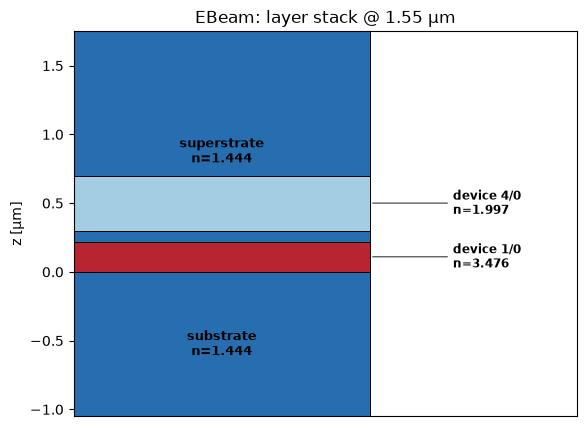
1 · The technology — a two-core vertical stack¶
The escalator uses the shared examples/tech.yaml — no device-specific
technology needed. It already defines two device layers: Si (n≈3.48) is
the lower core; SiN (n≈2.0) is the upper core, 0.3 µm above it; both are clad
in SiO₂ (n≈1.44). Each material carries a neutral nk so the free beamz engine
can resolve indices offline, plus per-engine hints (tidy3d, lumerical) for
the commercial solvers — one technology file, every engine.
plot_tech_stack(tech, wavelength_um=1.55)
plt.show()
2 · The device — two patterned cores¶
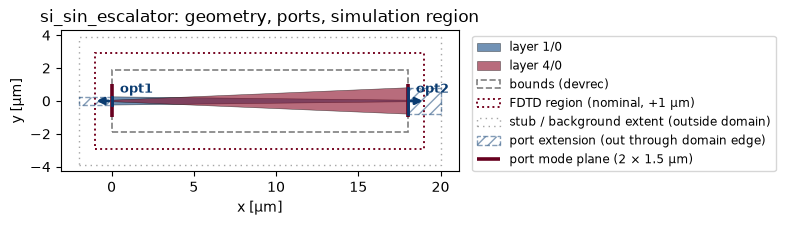
We load si_sin_escalator.gds (KLayout/SiEPIC) and pair it with the technology
to build a Component. Ports are auto-detected from the pin layer: opt1 on
the Si layer (west, z≈0.11 µm) and opt2 on the SiN layer (east, z≈0.5 µm).
Passing a SimulationSpec also sketches the FDTD region (device bounds + a
buffer) and the port-extension stubs that carry each port out through the
PML. It’s a schematic of the setup — the exact margins are engine-specific
(beamz uses its own fixed guard band); the full run spec is defined in §3.
cell, _layout = load_cell(str(HERE / "si_sin_escalator.gds"))
component = load_component_from_tech(cell=cell, tech=tech)
component.name = "si_sin_escalator"
print("ports:")
for p in component.ports:
    print(f"  {p.name}: center={[round(float(c), 3) for c in p.center]} µm, dir={p.direction}°")

plot_component(component, spec=SimulationSpec())
plt.show()
18:55:10 PDT WARNING: Using canonical configuration directory at
             '/home/mustafa/.config/tidy3d'. Found legacy directory at
             '~/.tidy3d', which will be ignored. Remove it manually or run
             'tidy3d config migrate --delete-legacy' to clean up.
ports:
  opt1: center=[0.0, 0.0, 0.11] µm, dir=180°
  opt2: center=[18.0, 0.0, 0.5] µm, dir=0°
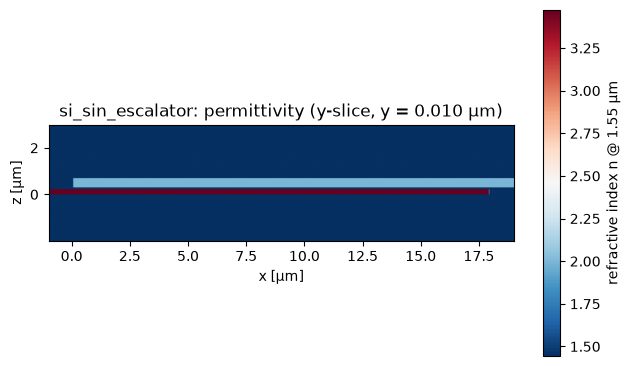
The top-down view collapses the stack. The refractive-index cross-section along the waveguide (the x–z plane the solver actually rasterizes) shows the two cores directly: the Si core enters from the left and tapers away, while the SiN core rises above it and carries the light out to the right — the “escalator.”
plot_permittivity(component, axis="y", position=0.0, wavelength_um=1.55)
plt.show()
The two modes the escalator connects¶
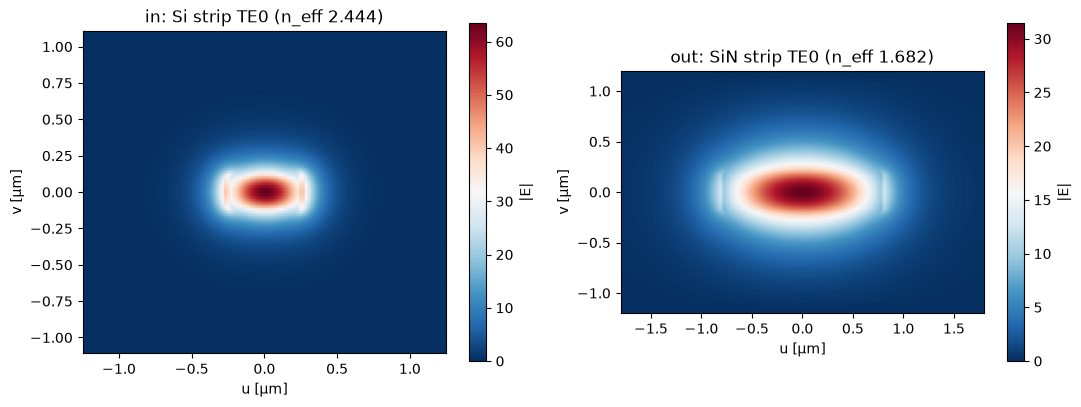
What actually transfers is a guided mode: the light enters as the Si strip’s TE0 and must leave as the SiN strip’s TE0. Both are solved offline below (tidy3d’s free local mode solver). The SiN mode is larger and less confined (lower index contrast), and the taper adiabatically morphs one into the other.
from gds_fdtd.grid import resolve_index  # noqa: E402
from gds_fdtd.modes import waveguide_mode  # noqa: E402
from gds_fdtd.plotting import plot_mode  # noqa: E402

n_clad = resolve_index(tech.superstrate.material, 1.55).real
ports_by_z = sorted(component.ports, key=lambda p: p.center[2])
si_port, sin_port = ports_by_z[0], ports_by_z[-1]  # Si core low, SiN core high
si_layer = min(tech.device, key=lambda d: d.z_base)
sin_layer = max(tech.device, key=lambda d: d.z_base)
si_mode = waveguide_mode(
    si_port.width, abs(si_layer.z_span), resolve_index(si_layer.material, 1.55).real, n_clad, 1.55
)[0]
sin_mode = waveguide_mode(
    sin_port.width,
    abs(sin_layer.z_span),
    resolve_index(sin_layer.material, 1.55).real,
    n_clad,
    1.55,
)[0]
fig, ax = plt.subplots(1, 2, figsize=(11, 4))
plot_mode(si_mode, ax=ax[0])
ax[0].set_title(f"in: Si strip TE0 (n_eff {si_mode.n_eff.real:.3f})")
plot_mode(sin_mode, ax=ax[1])
ax[1].set_title(f"out: SiN strip TE0 (n_eff {sin_mode.n_eff.real:.3f})")
fig.tight_layout()
plt.show()
18:55:14 PDT WARNING: Use the remote mode solver with subpixel averaging for
             better accuracy through 'tidy3d.web.run(...)' or the deprecated
             'tidy3d.plugins.mode.web.run(...)'. Alternatively, you can install
             the package 'tidy3d-extras' using 'pip install "tidy3d"' and set
             'config.simulation.use_local_subpixel=True'.
             WARNING: Permittivity spatial data array does not fully cover the
             requested region.
18:55:15 PDT WARNING: Permittivity spatial data array does not fully cover the
             requested region.
3 · Set up and run — on the free engine¶
validate() / build() / estimate() are offline and free — preview the
whole job before spending anything. beamz then runs one FDTD per port
excitation (two here) on the CPU. (For repeat runs, run_cached(cache_dir)
hashes the job and reloads the stored SMatrix — see
06_convergence_and_caching.)
from gds_fdtd.solvers import get_solver  # noqa: E402

spec = SimulationSpec(
    wavelength_start=1.5, wavelength_end=1.6, wavelength_points=11, mesh=6, z_min=-1.0, z_max=1.11
)
solver = get_solver("beamz")(component, technology=tech, spec=spec)

print("validate():", solver.validate() or "OK — no problems")
print("build():   ", solver.build().summary)
print("estimate():", solver.estimate())
validate(): OK — no problems
● Done: Raster cache hit (3d): 6a20766e0b60e7cf645b89503dd6ac648a2608e261b022101d06206bec9fb602.npz | load=0.23s
build():    {'n_ports': 2, 'grid_shape': (76, 87, 322), 'dx_nm': 74.31914077483697, 'n_core': 3.476, 'n_clad': 1.444, 'n_simulations': 2}
estimate(): ResourceEstimate(grid_cells=2129064, memory_gb=0.102195072, n_simulations=2, cost_hint='free local compute (JAX; CPU works, GPU if available)')
smatrix = solver.run()  # one FDTD per port; ~1-2 min on a CPU
print("S-matrix:", smatrix.port_names, "| modes:", smatrix.n_modes, "| freqs:", smatrix.f.size)
S-matrix: ['opt1', 'opt2'] | modes: 1 | freqs: 11
4 · S-parameters¶
The through path opt1→opt2 should be near 0 dB (an efficient adiabatic
transfer) with deep back-reflection at opt1.
plot_smatrix(smatrix, kind="db")
plt.show()


def thru(sm: SMatrix) -> np.ndarray:
    return sm.magnitude_db(out=sm.port_names[1], in_=sm.port_names[0])


def refl(sm: SMatrix) -> np.ndarray:
    return sm.magnitude_db(out=sm.port_names[0], in_=sm.port_names[0])


back = smatrix.magnitude_db(out=smatrix.port_names[0], in_=smatrix.port_names[1])
print(f"beamz through opt1→opt2: {float(np.nanmax(thru(smatrix))):+.2f} dB peak")
print(
    f"beamz through opt2→opt1: {float(np.nanmax(back)):+.2f} dB peak  (≈ opt1→opt2: near-reciprocal)"
)
print(f"beamz reflection opt1:   {float(np.nanmax(refl(smatrix))):+.2f} dB peak")
print("passive:", smatrix.is_passive(atol=0.05))
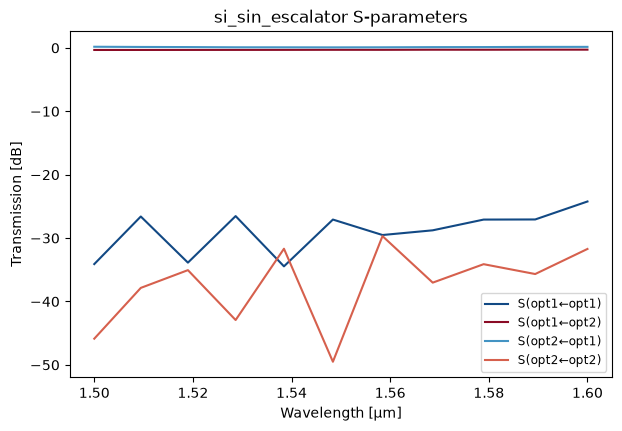
beamz through opt1→opt2: +0.18 dB peak
beamz through opt2→opt1: -0.28 dB peak  (≈ opt1→opt2: near-reciprocal)
beamz reflection opt1:   -24.23 dB peak
passive: True
5 · The field — light climbing the escalator¶
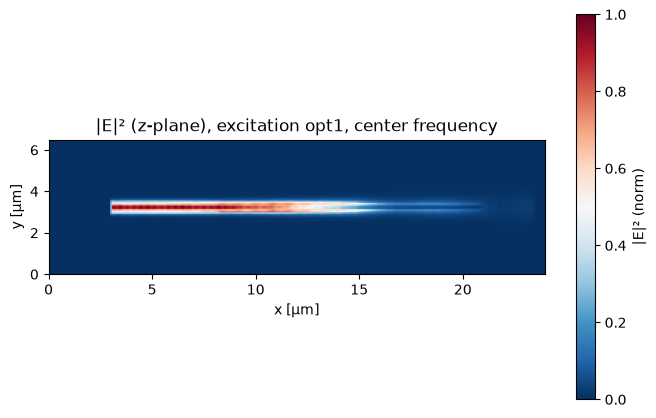
The frequency-domain |E|² profile at the Si-core plane: the mode enters on the
Si waveguide (left) and its energy leaves the Si plane as it transfers up into
the SiN core — the vertical hand-off in action.
solver.plot_fields(axis="z")
plt.show()
6 · Cross-validation — free vs commercial¶
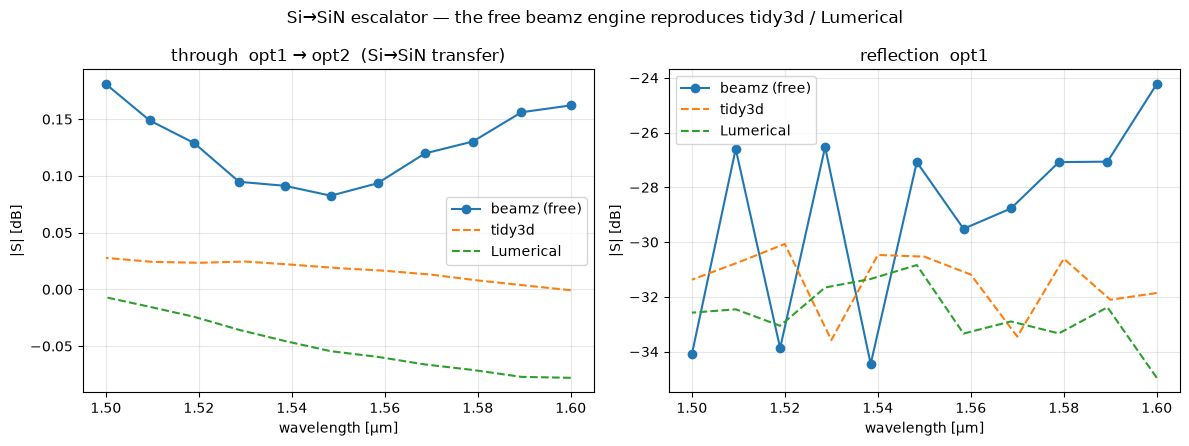
beamz is the only engine executed in this notebook. The tidy3d
and Lumerical curves are pre-recorded reference results (recorded/, see
PROVENANCE.md) from an earlier live validation on those engines for the
identical device — they are not re-run here (that needs cloud credits / a
license). Overlaying the free beamz result on them: the three engines agree on
the through transfer to within ~0.1–0.2 dB, and all show deep reflection.
ref_tidy3d = SMatrix.from_npz(str(HERE / "recorded" / "si_sin_escalator_tidy3d.npz"))
ref_lumerical = SMatrix.from_npz(str(HERE / "recorded" / "si_sin_escalator_lumerical.npz"))

fig, ax = plt.subplots(1, 2, figsize=(12, 4.5))
for sm, label, style in [
    (smatrix, "beamz (free)", "o-"),
    (ref_tidy3d, "tidy3d", "--"),
    (ref_lumerical, "Lumerical", "--"),
]:
    ax[0].plot(sm.wavelength_um, thru(sm), style, label=label)
    ax[1].plot(sm.wavelength_um, refl(sm), style, label=label)
ax[0].set_title("through  opt1 → opt2  (Si→SiN transfer)")
ax[1].set_title("reflection  opt1")
for a in ax:
    a.set_xlabel("wavelength [µm]")
    a.set_ylabel("|S| [dB]")
    a.grid(alpha=0.3)
    a.legend()
fig.suptitle("Si→SiN escalator — the free beamz engine reproduces tidy3d / Lumerical")
fig.tight_layout()
plt.show()
print(f"{'wavelength':>10} | {'beamz':>8} {'tidy3d':>8} {'lumerical':>10}   (through, dB)")
grid = ref_tidy3d.wavelength_um
for i, wl in enumerate(grid):
    b = float(np.interp(wl, smatrix.wavelength_um[::-1], thru(smatrix)[::-1]))
    print(
        f"{wl:>10.3f} | {b:>8.2f} {float(thru(ref_tidy3d)[i]):>8.2f} {float(thru(ref_lumerical)[i]):>10.2f}"
    )
wavelength |    beamz   tidy3d  lumerical   (through, dB)
     1.600 |     0.16    -0.00      -0.08
     1.590 |     0.16     0.00      -0.08
     1.580 |     0.13     0.01      -0.07
     1.570 |     0.12     0.01      -0.07
     1.560 |     0.10     0.02      -0.06
     1.550 |     0.08     0.02      -0.05
     1.540 |     0.09     0.02      -0.05
     1.530 |     0.09     0.02      -0.04
     1.520 |     0.13     0.02      -0.02
     1.510 |     0.15     0.02      -0.02
     1.500 |     0.18     0.03      -0.01
Recap & next¶
The Si→SiN escalator is a multi-layer device (two cores at different z);
get_solver("beamz")builds and runs it on the free engine — no cloud account, no license.Through transfer ≈ 0 dB with deep reflection, matching recorded tidy3d and Lumerical to ~0.1–0.2 dB: physics you can trust from a zero-cost solver.
Same pattern as everywhere:
Component+Technology+SimulationSpec→SMatrix. See07_choosing_an_enginefor the identical-job three-engine comparison on a single-layer device, and04_reading_resultsfor the fullSMatrixanalysis surface.