Multi-Modal Simulations
Multi-modal simulations track several waveguide modes, typically TE (mode 1) and TM (mode 2), through one device: polarization-dependent loss, mode conversion, and polarization-insensitive design all need them.
Enable with one field
from gds_fdtd.spec import SimulationSpec
from gds_fdtd.solvers import get_solver

spec = SimulationSpec(modes=(1, 2), wavelength_points=51, z_min=-1.0, z_max=1.11)
solver = get_solver("tidy3d")(component, technology=tech, spec=spec)
smatrix = solver.run()
Mode ids are 1-based package-wide: mode 1 = fundamental TE-like, mode 2 =
TM-like. tidy3d and Lumerical support multimode; beamz v1 is single-mode
TE (its capabilities.supports_multimode says so and validate()
rejects multi-mode jobs).
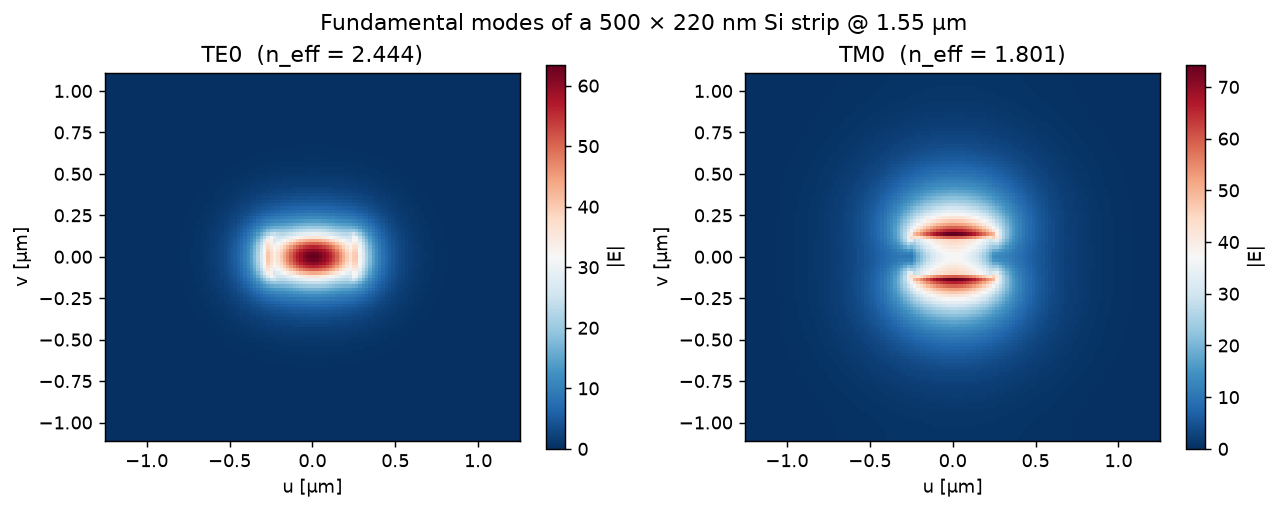
The two modes a multi-mode job tracks, from the local mode solver: TE0 (E in-plane, tightly confined) and TM0 (E vertical, lower index, less confined). The confinement difference is what polarization devices exploit.
Reading a multi-mode S-matrix
Every path is indexed by (out_port, in_port, out_mode, in_mode):
thru_te = smatrix.magnitude_db(out="opt4", in_="opt1", mode_out=1, mode_in=1)
thru_tm = smatrix.magnitude_db(out="opt4", in_="opt1", mode_out=2, mode_in=2)
conversion = smatrix.magnitude_db(out="opt4", in_="opt1", mode_out=2, mode_in=1)

# polarization-dependent loss across the band
pdl_db = abs(thru_te - thru_tm)
Curated plotting, mode-preserving paths only (conversion terms of a symmetric device sit at the noise floor and only clutter the plot):
from gds_fdtd.plotting import plot_smatrix

paths = [
    ("opt4", "opt1", 1, 1), ("opt4", "opt1", 2, 2),  # thru TE / TM
    ("opt1", "opt1", 1, 1), ("opt1", "opt1", 2, 2),  # reflection TE / TM
]
plot_smatrix(smatrix, kind="db", paths=paths)
By default plot_smatrix hides paths whose peak is below −60 dB, so a
full 4-port × 2-mode matrix (64 paths) stays readable.
Physics checks work per mode-flattened matrix:
smatrix.is_reciprocal()   # S == S^T over (port, mode) pairs
smatrix.is_passive()      # no excitation outputs more power than it got
Exports carry modes too: to_dat() writes per-mode entries INTERCONNECT
understands, and to_touchstone() flattens (port, mode) pairs port-major
(the convention is written into the file header).
Polarization devices
Multi-mode S-parameters are how you design and verify polarization components. A directional coupler, for instance, transfers TM across its gap far faster than TE, so one length routes the two polarizations to different ports:
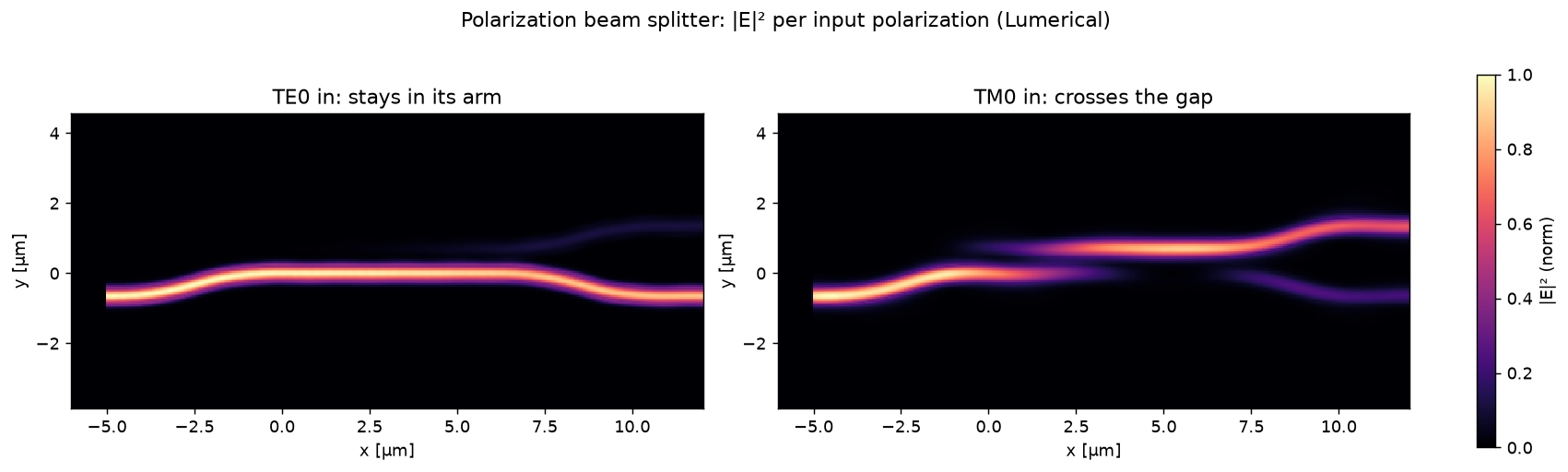
A polarization beam splitter: with a TE0 input the field stays in its arm; with TM0 it crosses the gap. Worked end to end (splitter and splitter-rotator) in 10b · Polarization: a splitter and a splitter-rotator.
Symmetry can halve multi-mode cost
For z-symmetric stacks, symmetry=(0, 0, 1) selects TE-like modes and
(0, 0, -1) TM-like; check your stack really is symmetric before using
it (the crossing example runs with no symmetry for exactly that reason).